Creator, Not Consumer: A Different Angle on Screen Time
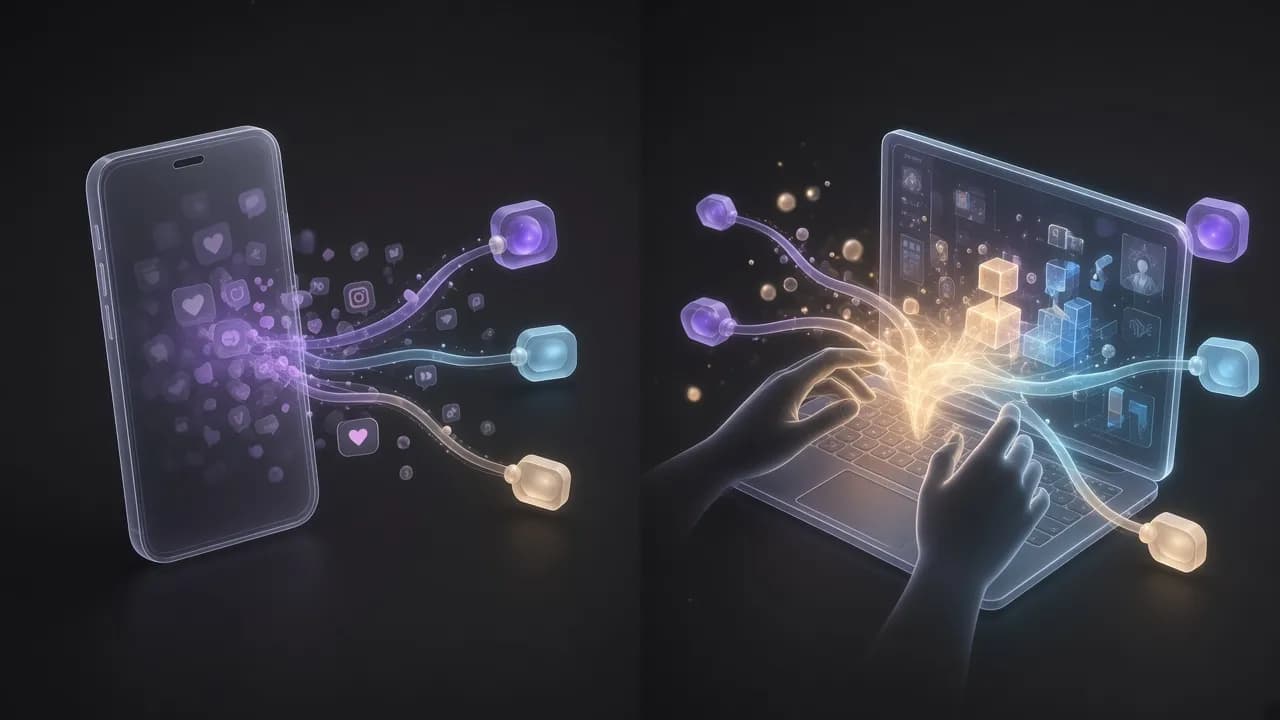
Screen time is not one number. Weekly projects, working screens, and demo day should not sit in the same box as passive scrolling.
Why screen time is not one number
Most parents track screen time as total minutes. That measure is practical but blind: in the same hour one child watches clips, one plays a game, one fixes a button in their own project.
All three get the same “screen” label; they do not have the same effect. Pushing the debate into ban-or-allow exhausts many families. A more useful split is consumption versus production.
What production means
In producer mode a child carries a concrete weekly output: a button that works, a screen that changed, a mini project explained on demo day.
Passive scrolling has no output; only spent time. Production has output; time can stay bounded. “Four hours on a screen” does not separate “four hours of unfinished browsing” from “four hours on a finished slice” — it should.
In an AI-assisted coding course, production is defined: idea, build, test, present. That is not “ask ChatGPT and paste the answer”.
The AI consumption trap
AI speeds up production and also makes consumption easier. If a child only collects ready answers, screen time rises while skill does not.
On the course side, AI output is verified: run it, see the error, fix, try again. That loop helps break pure consumption and the magic-wand expectation.
A useful parent signal: What did my child finish on screen, and what will they show next week?
Motivation in a group
In a ten-person group, peers can move a shy student; demo day gives a “I built this” moment that stands apart from grades.
Not every child moves at the same speed. Group classes offer structure; one-to-one mentorship offers personal pace. Both stay production-focused; the difference is tempo and feedback frequency.
How this relates to school is a separate topic in coding and school success.
Why four weeks is a reasonable box
Open-ended “course forever” promises tire parents. Four weeks, six live sessions, final demo: bounded and finishable.
At the end the child holds proof; the parent gets a short progress summary. That does not lock the screen into endless consumption.
Next step
Program details for ages 11–14 are on software development and for 15–18 on product development. An intro call covers interests and the right format.